Manual EOB Posting Takes Too Much Billing Staff Time
Manual posting requires staff to review payer responses, enter payments, calculate adjustments, update balances, and track denials by hand.
EMR-EHRs Electronic Insurance Payment Posting Software helps healthcare practices review insurance payment details, post payments, apply adjustments, identify denials, update patient responsibility, manage posting exceptions, update A/R balances, and maintain secure payment posting history where supported.
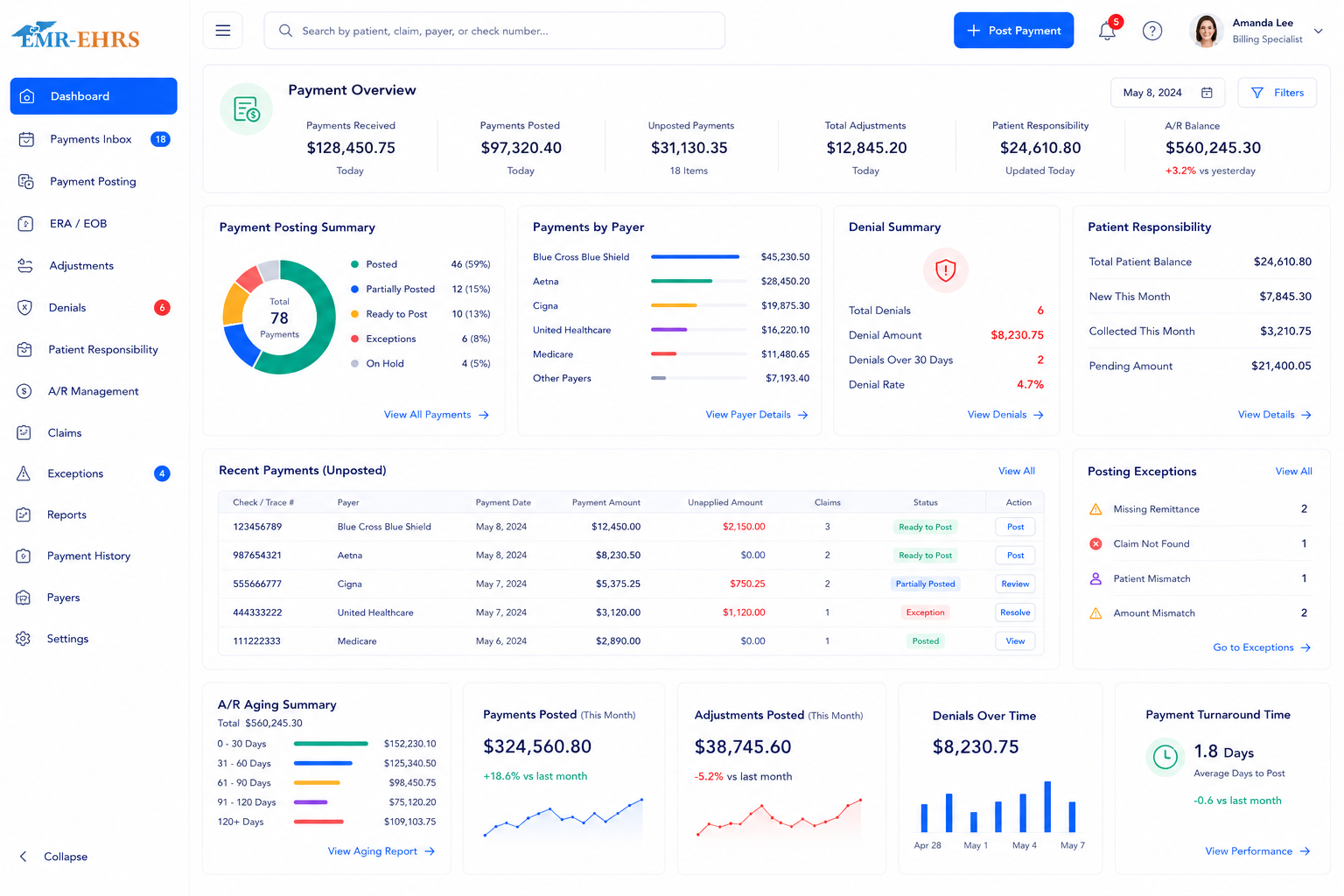
Electronic insurance payment posting software helps healthcare practices review payer payment details and post insurance payments, adjustments, denials, and patient responsibility to claims and patient accounts. It can support EOB review, payment batch review, claim matching, line-level posting, adjustment posting, denial review, patient responsibility transfer, secondary balance updates, exception worklists, A/R updates, and payment reports where supported.
EMR-EHRs Electronic Insurance Payment Posting Software helps billing teams review insurance payment and EOB details, post payments, apply adjustments, identify denials, update patient responsibility, manage posting exceptions, update A/R balances, and maintain secure payment posting history where supported.
Healthcare practices need more than manual EOB posting. They need a connected payment posting workflow that supports insurance payment review, EOB entry, payment batches, claim matching, adjustments, denials, patient responsibility, secondary balances, exceptions, A/R updates, and reports.
Manual posting requires staff to review payer responses, enter payments, calculate adjustments, update balances, and track denials by hand.
Billing teams need a clear way to review payer payments, claim details, allowed amounts, paid amounts, adjustments, denials, and patient responsibility.
Payment batches should be reviewed against EOB totals, check amounts, deposit amounts, payer totals, and posting totals where supported.
If payments are matched to the wrong claim or patient account, practices may see incorrect balances, duplicate posting, wrong patient responsibility, or inaccurate A/R.
Payments, adjustments, denials, deductibles, copays, coinsurance, write-offs, and remaining balances may need service-line-level review.
Incorrect adjustment posting can distort payer performance, account balances, patient responsibility, and financial reports.
Billing teams need to see denial details, adjustment reasons, payer notes, and follow-up needs where supported.
Deductibles, copays, coinsurance, non-covered amounts, and remaining balances should be reviewed before moving balances to the patient.
Primary payment posting should correctly prepare secondary or tertiary balances, coordination of benefits details, remaining responsibility, and payer sequencing where supported.
Missing claims, payer mismatches, duplicate payment warnings, balance conflicts, and variance issues need review where supported.
Billing teams may need to compare expected payment, actual payment, payer contract expectations, refunds, recoupments, and variances where supported.
Payment posting should update claim balances, patient balances, insurance balances, secondary balances, A/R aging, payer aging, and open balance worklists.
Practice managers need visibility into posted payments, unposted payments, EOB batches, adjustments, denials, underpayments, overpayments, and A/R impact.
Payment posting includes patient financial data, claim details, payer responses, adjustments, write-offs, user actions, and account balances.
Billing teams receive insurance payment details, payer responses, EOB information, check details, or deposit information.
Staff reviews or enters EOB payment details, payer information, claim details, adjustment details, denial details, and patient responsibility where supported.
Staff reviews payer name, check number, deposit reference if supported, payment date, posting date, patient, claim, and service details.
The system supports payment batch review, batch totals, posting date, payer total, payment total, adjustment total, denial total, and patient responsibility total where supported.
Billing staff compares payment totals with check, deposit, payer, or batch control totals where supported.
Payments are matched to the correct claim, patient account, provider, payer, date of service, and service line where supported.
Staff reviews billed amount, allowed amount, paid amount, adjustment amount, denied amount, patient responsibility, and remaining balance.
Service-line details such as CPT/HCPCS line item, date of service, allowed amount, paid amount, adjustment, deductible, copay, coinsurance, and balance are reviewed where supported.
Billing teams review denial details, adjustment reasons, payer notes, and follow-up needs where supported.
Payments are posted to the correct claim or service line where supported.
Contractual adjustments, write-offs, deductibles, copays, coinsurance, non-covered amounts, and patient responsibility are applied where supported.
Denied or unpaid services are routed to denial, claim follow-up, exception, or A/R worklists where supported.
Primary payment details, coordination of benefits information, remaining balance, and secondary or tertiary responsibility are prepared where supported.
Missing claims, balance mismatches, duplicate payment warnings, underpayments, overpayments, or payer mismatches are flagged where supported.
Billing staff reviews payment variances, expected vs actual payment, refunds, recoupments, and payer follow-up tasks where supported.
Posting updates insurance balance, patient balance, secondary balance, remaining balance, A/R aging, payer aging, patient aging, and open balance follow-up.
The system maintains payment posting history, adjustment history, payment corrections, and user activity where supported.
Managers review payment totals, adjustments, denials, posting exceptions, underpayments, overpayments, A/R impact, payer trends, and staff productivity.
Confirm support for automatic claim matching, line matching, duplicate payment detection, or matching algorithms, including configuration and implementation requirements, during evaluation.
HIPAA-focused payment posting workflow, designed to support secure billing access, audit-friendly payment posting records, and role-based payment posting permissions.
AI-powered payment posting tools should support billing review and staff efficiency while billing teams remain responsible for final payment posting, adjustment review, denial follow-up, balance updates, reconciliation, and compliance decisions.
Summarize payment details, payer response, adjustment details, and patient responsibility for billing review.
Surface denial details, underpayment flags, overpayment flags, and posting exception context where available.
Help billing teams prioritize exceptions, open balances, payer follow-up, and A/R worklists.
Review EOB details, post payments, apply adjustments, manage exceptions, update balances, and route denials where supported.
Track payment posting, payer responses, denials, underpayments, overpayments, A/R updates, and follow-up worklists.
Monitor payment totals, posting backlogs, adjustment trends, denial trends, patient responsibility, A/R performance, and staff productivity.
Manage user permissions, payment posting reports, secure access, batch review, and audit-friendly activity.
Review provider-specific payments, adjustments, denials, patient responsibility, and A/R balances where supported.
Track payment posting, payer payments, patient balances, and A/R impact across locations where supported.
Manage specialty payer payments, procedure-related posting, high-adjustment workflows, denial-heavy payment activity, and follow-up worklists where supported.
Review payment totals, deposit reconciliation, adjustment amounts, write-offs, patient responsibility, and A/R impact where supported.
| Workflow Area | Manual EOB Posting | EMR-EHRs Electronic Payment Posting |
|---|---|---|
| Payment review | Paper EOB review | Electronic payment review where supported |
| Payment entry | Manual entry | Payment posting workflow where supported |
| Claim matching | Manual matching | Claim matching where supported |
| Line-item posting | Manual calculation | Line-level posting where supported |
| Adjustments | Manual write-off entry | Adjustment posting workflow |
| Denials | Easy to miss | Denial visibility where supported |
| Patient responsibility | Manual balance transfer | Patient responsibility posting where supported |
| Exceptions | Manual notes | Exception worklists where supported |
| A/R updates | Spreadsheet or manual review | A/R balance update workflow |
| Reports | Manual tracking | Payment, adjustment, denial and A/R reports |
| Security | Paper files or shared spreadsheets | Role-based access and audit-friendly history |
This conceptual workflow preview illustrates a electronic payment posting dashboard mockup.
Payment, adjustment and responsibility totals.
Claim and service-line review where supported.
Payer responses and follow-up routing.
Payment review support where available.
EMR-EHRs helps practices review payment details, post payments, update balances, and connect payment activity to claims and A/R where supported.
EMR-EHRs supports EOB entry, payment batch visibility, payer payment details, claim-level details, and posting history where supported.
EMR-EHRs helps billing teams post paid amounts, contractual adjustments, write-offs, patient responsibility, and remaining balances where supported.
EMR-EHRs can support denial details, payer notes, and follow-up worklists where available.
EMR-EHRs helps practices review unmatched payments, balance mismatches, posting exceptions, batch totals, and deposit reconciliation where supported.
EMR-EHRs helps teams update claim balances, patient balances, secondary balances, payer aging, patient aging, and A/R worklists where supported.
EMR-EHRs supports role-based billing access, secure financial data, and audit-friendly payment posting activity where supported.
EMR-EHRs can support payment summaries, denial summaries, variance summaries, exception prioritization, and A/R follow-up suggestions where available.
EMR-EHRs helps configure payment posting workflows, EOB entry, payment batches, claim matching, adjustments, patient responsibility, reports, permissions, and staff training.
Review current payment posting workflow, EOB posting, claim matching, adjustments, denials, patient responsibility, A/R updates, reports, and user roles.
Configure EOB entry, payment detail review, payer setup, posting dates, claim details, adjustment details, denial details, and patient responsibility where supported.
Configure payment batches, batch totals, deposit review, check amount review, posting totals, and reconciliation workflows where supported.
Configure claim matching, patient account matching, service-line matching, missing claim warnings, and correction workflows where supported.
Configure claim-level posting, line-level posting, allowed amount, paid amount, adjustment, denial, deductible, copay, coinsurance, and balance workflows where supported.
Configure contractual adjustments, write-offs, adjustment categories, approval workflows if supported, and adjustment history.
Configure denial visibility, payer responses, denial worklists, corrected claim tasks, appeal tasks, and follow-up notes where supported.
Configure patient responsibility, secondary balances, tertiary balances if supported, coordination of benefits review, and statement readiness where supported.
Configure exception queues, mismatch review, duplicate warnings if supported, underpayment review, overpayment review, and resolution status where supported.
Configure A/R balance updates, payer aging, patient aging, payment reports, adjustment reports, denial reports, reconciliation reports, and staff productivity views.
Configure role-based billing access, payment posting permissions, adjustment permissions, write-off permissions, report access, and audit-friendly history.
Train billing teams, RCM teams, practice managers, administrators, finance users, and related staff.
Monitor payment totals, posting exceptions, denial visibility, balance updates, A/R impact, report usage, and workflow feedback.
Electronic insurance payment posting software helps healthcare practices review payer payment details and post insurance payments, adjustments, denials, and patient responsibility to claims and patient accounts. EMR-EHRs Electronic Insurance Payment Posting Software supports EOB review where supported, claim matching where supported, payment posting, adjustment posting, patient responsibility updates, A/R updates, and secure payment history.
EMR-EHRs helps billing teams review insurance payment details, payment batches, payer information, claim details, allowed amounts, paid amounts, adjustment amounts, denial details, and patient responsibility where supported. It can also support claim matching, line-level posting, posting exceptions, balance updates, and payment posting reports where available.
Yes, where supported. EMR-EHRs Electronic Insurance Payment Posting Software can help post insurance payments, allowed amounts, contractual adjustments, write-offs, deductibles, copays, coinsurance, denied amounts, remaining balances, and patient responsibility. It also helps maintain payment posting history, adjustment history, and audit-friendly billing activity.
EMR-EHRs can support denial visibility during payment posting where available, including denial amounts, denial reasons, payer responses, denial worklists, corrected claim tasks, appeal tasks, and follow-up notes. This helps billing teams connect payer responses with claim follow-up and A/R worklists.
Practices should use integrated payment posting because manual EOB posting can create claim matching errors, missed denials, incorrect adjustments, wrong patient balances, delayed A/R updates, and extra spreadsheet work. EMR-EHRs Electronic Insurance Payment Posting Software supports connected EOB review, payment posting, adjustments, patient responsibility updates, exception review, A/R visibility, reporting, and audit-friendly payment history where supported.
Review insurance payment details, post payments, apply adjustments, manage denials, update patient responsibility, reconcile balances, and track A/R activity with EMR-EHRs Electronic Insurance Payment Posting Software where supported.
Phone: (480) 782-1116 | Email: [email protected]
Customer Experiences
Read customer feedback about EMR implementation, practice management workflows, billing, training, support, documentation, scheduling, and daily medical office operations.
Read full testimonialHello my name is Sarah and I wanted to take a minute and tell you about my experience implementing a Podiatry EMR program. We researched for about 18 months and in doing so looked at over 20 different EMR programs. We recently went live with IMS through 1st Providers Choice and were completely thrilled that during the first two months of the transition of going paperless, we showed an increase in productivity even during training and the implementation process. The more we are in the software, the more we find that it has so many capabilities to be efficient for my doctors, my billing coordinator, and the front desk. Support has been good, there were a few occasions where we needed things off business hours, and even then 1st Providers Choice was there for us. We were glad we took our time and looked at several programs before making a decision.
Read full testimonialWe began implementing IMS in our office in April of 2011. This transition was made exceptionally easy with the help of 1st Providers Choice support staff. 1st Providers Choice support staff was quick to respond to all of our support needs during implementation and with any of our current support needs. We were uncertain and a little skeptical about bringing the billing in house because I had never done billing before. Our office was able to bring billing in house during this time of implementing IMS and our revenue is up and our turnaround time is quicker than ever before. We are happy that we decided to go with 1st Providers Choice and made the transition to utilizing IMS for Podiatry.
Read full testimonialChoosing 1st Providers Choice as a business partner has been an excellent choice for our office. We received extensive training from the educational team and find the program to be very user friendly. Scheduling is easy and our billing process has been greatly expedited. The EHR part of the program is easy to work, saves time and helps prevent errors. We have successfully implemented the built-in fax and camera features. 1st Providers Choice is a progressive company that keeps up-to-date on laws and changes and offers excellent support. Thanks, 1st Providers Choice, for helping our office run more efficiently. We really like this program.
Read full testimonialMy bad-debt write-offs have been reduced over 90%. Pre-IMS, we had an average of $80,000 per month outstanding in charges waiting for referral. Since implementation of IMS we now regularly maintain no more than $400 per month. The Authorization tracking screen helps us in timely follow-up with the insurance companies. The billing module is great, in a way we now know what ensures timely payments. The aging reports help our billers set priority of follow-ups, making sure we work in the right areas.
Read full testimonialI just wanted to say that I love IMS!!! We have had other programs in the past but IMS is super!!!! I can bill out charges, enter patient demographics, print patient statements and read the patient ledger much easier. My favorite part of IMS is the billing part. It is so easy to read!!!! Makes my job easier!!!! Thank You!!!
Read full testimonialIMS has improved the billing payment turnaround time. The denied claims have been reduced drastically. The implementation process was smooth and the system is very user friendly.