Practices May Not Have a Clear Implementation Owner
Without ownership, setup tasks, workflow decisions, user training, and go-live readiness can become delayed or inconsistent.
EMR-EHRs EMR Implementation, Installation and Setup Services help medical practices plan, configure, test, train, launch, and optimize EMR workflows for providers, clinical staff, front desk teams, billing teams, practice managers, and administrators.
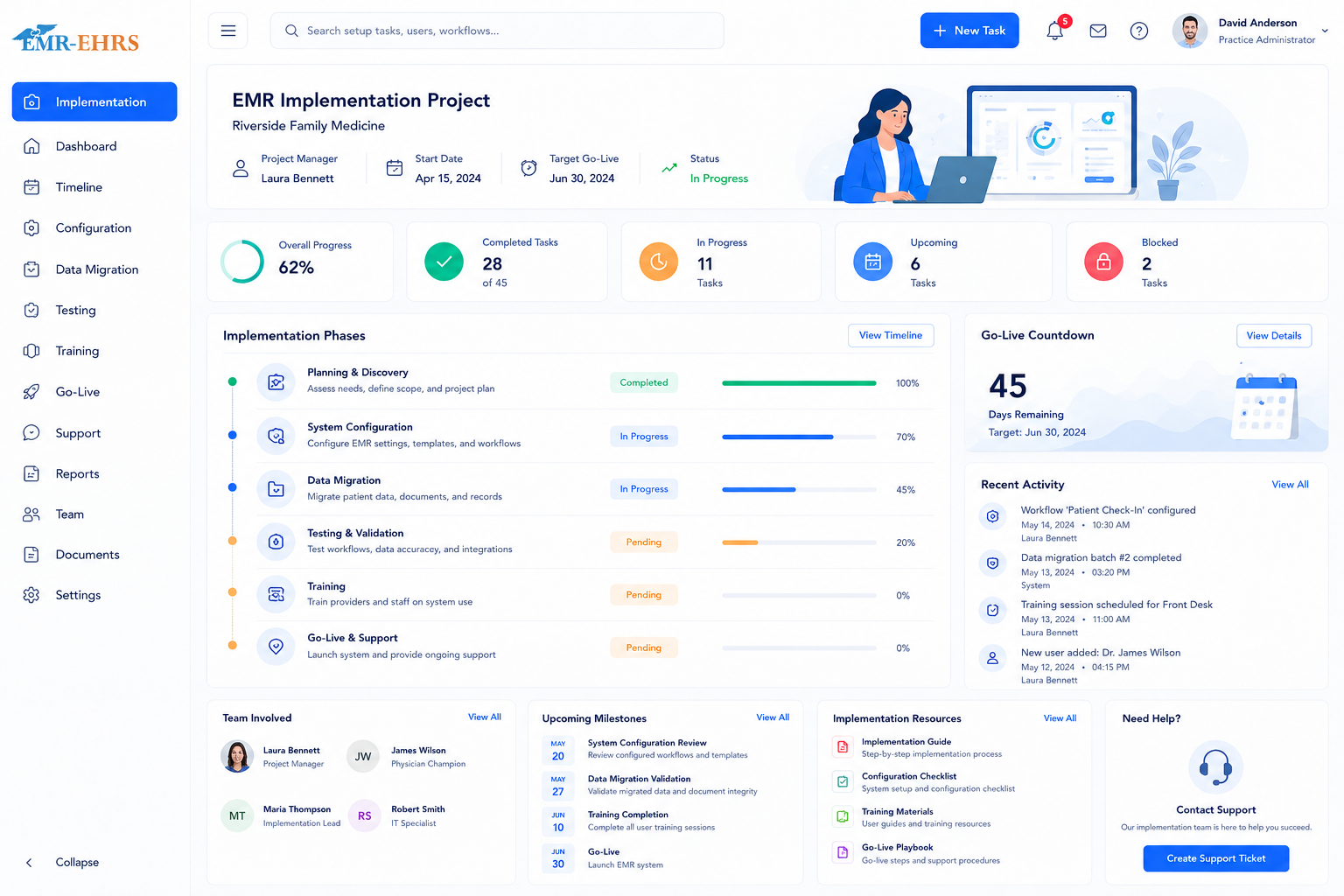
EMR implementation services help medical practices set up and launch electronic medical records software. The process can include readiness review, workflow planning, system configuration, user and role setup, provider setup, template setup, scheduling setup, billing workflow setup, testing, staff training, go-live support, and post-live optimization where supported.
EMR-EHRs EMR Implementation Services help medical practices configure EMR workflows, train users, prepare for go-live, and support adoption across clinical, front desk, billing, reporting, and administrative teams where supported.
Healthcare practices need a structured EMR implementation plan because setup affects providers, clinical staff, front desk teams, billing users, managers, administrators, patient workflows, reporting, and long-term adoption.
Without ownership, setup tasks, workflow decisions, user training, and go-live readiness can become delayed or inconsistent.
Old paper workflows, manual steps, or disconnected software processes may need to be mapped before setup begins.
Clinical documentation, templates, visit notes, diagnosis workflows, and charting preferences must support provider adoption where available.
Front desk, clinical, billing, and admin users need workflow-specific setup and training.
Incorrect permissions can affect chart access, billing access, reporting access, user activity, and secure workflow control.
Generic templates may not support specialty documentation, procedure notes, visit types, or provider preferences.
Diagnosis, CPT/HCPCS, charge entry, pre-claim checks, claims, payment posting, and reports may need proper workflow setup.
Patient records, documents, appointments, insurance, and billing data may require migration planning before go-live.
Portal, ePrescribing, labs, imaging, clearinghouse, eligibility, claims, payment, or API workflows should be tested where verified.
Providers, clinical staff, front desk users, billers, managers, administrators, and super users need training based on their roles.
Launch support needs a clear checklist, support contacts, issue tracking, escalation process, and workflow troubleshooting.
After launch, practices often need template refinements, report updates, permissions review, workflow adjustments, and training follow-up.
Role-based access, chart permissions, billing permissions, report permissions, admin rights, and user activity controls need review.
AI-assisted setup review can summarize gaps where available, but final configuration, validation, and go-live approvals remain with EMR-EHRs implementation specialists and practice leaders.
EMR-EHRs reviews practice size, provider count, locations, specialties, current systems, staff roles, workflows, reports, launch goals, and timeline expectations.
Define which modules, workflows, users, locations, providers, templates, reports, integrations, and data migration items are included in the setup.
Map clinical, front desk, scheduling, check-in, check-out, documentation, billing, reporting, patient portal, and administrative workflows where supported.
Create setup requirements for practice settings, users, permissions, providers, locations, schedules, templates, chart fields, reports, billing workflows, and security.
Set up providers, clinical staff, front desk users, billing users, practice managers, administrators, permission groups, and role-based access where supported.
Configure provider profiles, locations, appointment types, visit types, availability, schedules, rooms, resources, and scheduling rules where supported.
Set up visit notes, SOAP notes, specialty templates, diagnosis workflows, procedure notes, follow-up instructions, signatures, and charting preferences where supported.
Configure demographics, contact fields, insurance fields, medical history, medications, allergies, problem lists, vitals, document categories, and chart summaries where supported.
Configure scheduling, appointment statuses, visit statuses, intake forms, demographic updates, eligibility checks, reminders, copay workflows, and front desk tasks where supported.
Set up patient portal accounts, forms, secure messages, reminders, visit summaries, statement access, online payment workflows, and communication templates where supported.
Configure charge entry, diagnosis workflows, CPT/HCPCS workflows, modifiers, pre-claim checks, claims, payment posting, collections, A/R, and billing reports where supported.
Coordinate legacy data review, patient demographics migration, clinical records migration, document migration, appointment migration, billing migration, validation, and archive strategy where supported.
Prepare and test ePrescribing, labs, imaging, patient portal, clearinghouse, eligibility, claims, payments, APIs, HL7/FHIR, and other verified connections.
Set up clinical reports, operational reports, appointment reports, productivity reports, billing reports, dashboards, report permissions, and validation.
Run system testing, workflow testing, sample patient testing, scheduling testing, documentation testing, billing testing, report testing, permission testing, and final sign-off.
Train providers, clinical staff, front desk teams, billing teams, practice managers, administrators, and super users based on their daily workflows.
Confirm staff readiness, provider readiness, template readiness, schedule readiness, billing readiness, report readiness, permissions, support contacts, escalation process, and final approval.
Support staff during launch with scheduling, documentation, check-in, billing tasks, reporting questions, configuration adjustments, issue tracking, and workflow troubleshooting.
Review templates, reports, permissions, adoption, user feedback, issue logs, workflow gaps, training gaps, and optimization opportunities after launch.
Support workflow changes, report refinements, template updates, new users, permission changes, and future setup adjustments where supported.
Confirm support for specialty templates, smart phrases, voice dictation, AI scribe, note locking, or addendums, including configuration and implementation requirements, during evaluation.
Confirm support for portal, secure messaging, forms, reminders, result access, statements, or online payments, including configuration and implementation requirements, during evaluation.
Confirm support for billing automation, claims, eligibility, payment posting, collections, or coding advisor functionality, including configuration and implementation requirements, during evaluation.
Coordinate with EMR Data Migration and Conversion Services where supported.
Confirm support for specific integrations, interfaces, APIs, HL7, FHIR, clearinghouse, labs, imaging, pharmacy, eligibility, or payment connections, including configuration and implementation requirements, during evaluation.
HIPAA-focused setup workflow, designed to support secure patient data access, audit-friendly setup and user activity records, and role-based clinical, billing and admin permissions.
AI-assisted implementation tools should support setup review and workflow readiness while EMR-EHRs implementation specialists, providers, staff, billers, managers and administrators remain responsible for final configuration, validation, approvals and go-live decisions.
Need efficient charting, templates, patient records, prescribing workflows, orders, tasks, and visit documentation where supported.
Need vitals workflows, intake tasks, chart updates, clinical task lists, documents, and provider support workflows.
Need scheduling, check-in, check-out, forms, demographic updates, eligibility workflows, and patient communication where supported.
Need charge entry, diagnosis workflows, coding, claims, payment posting, patient balances, and reports where supported.
Need implementation ownership, workflow visibility, training readiness, reports, issue tracking, staff adoption, and performance monitoring.
Need user setup, permissions, access controls, templates, configuration records, report access, and security workflows.
Need specialty templates, visit types, procedures, documents, reports, billing workflows, and specialty-specific setup where supported.
Need provider-location mapping, schedules, reporting, permissions, and standardized workflows across locations where supported.
| Workflow Area | Self-Setup | EMR-EHRs Implementation Services |
|---|---|---|
| Readiness planning | Often informal | Structured readiness and scope review |
| Workflow mapping | May be skipped | Clinical, front desk, billing and admin workflow planning |
| User roles | Manual guessing | Role-based user and permission setup |
| Templates | Generic setup | Template configuration where supported |
| Scheduling | Basic calendar setup | Provider, location and visit type setup |
| Billing workflows | Disconnected setup | Billing and claims workflow setup where supported |
| Data migration | Unclear ownership | Migration coordination where supported |
| Integrations | Risk of missed testing | Interface preparation and testing where supported |
| Reports | Basic setup | Report and dashboard configuration |
| Training | Inconsistent | Role-based training and go-live readiness |
| Go-live | Staff handles issues alone | Go-live support and issue tracking |
| Optimization | Often delayed | Post-live workflow review and recommendations |
This conceptual workflow preview illustrates how configuration, workflow mapping, testing, training, go-live preparation and post-launch optimization fit together.
Users, roles, providers, locations and schedules.
Clinical, front desk, billing and admin readiness.
Testing, training, checklist and support contacts.
Issue review, adoption and post-live refinements.
Compare implementation services by discovery depth, configuration scope, testing, training, launch support, responsibilities and measurable acceptance criteria.
EMR-EHRs helps practices define scope, workflows, users, locations, templates, integrations, reports, training needs, and launch timing.
EMR-EHRs supports clinical, front desk, billing, reporting, patient portal, and administrative workflow setup where available.
EMR-EHRs helps providers, staff, billers, managers, administrators, and super users prepare for launch.
EMR-EHRs helps coordinate data migration, document setup, interfaces, and workflow testing where available.
EMR-EHRs supports role-based access, permission review, user setup, and audit-friendly setup records where supported.
EMR-EHRs helps review workflows, issue logs, templates, reports, permissions, training gaps, and optimization opportunities after go-live.
EMR-EHRs can support setup summaries, workflow gap summaries, issue summaries, and go-live readiness summaries where available.
Review practice goals, users, locations, specialties, workflows, reports, modules, integrations, and launch expectations.
Map current and future workflows for providers, clinical staff, front desk, billing, managers, and administrators.
Configure users, roles, providers, locations, schedules, templates, chart fields, reports, permissions, and workflow settings.
Coordinate data migration, documents, legacy records, portal, ePrescribing, labs, imaging, claims, eligibility, payments, and related workflows where supported.
Test scheduling, documentation, billing, reporting, permissions, integrations, data workflows, and sample scenarios.
Train users by role, review readiness checklists, confirm support plans, and prepare launch communication.
Support staff during launch, track issues, answer questions, and review urgent workflow needs.
Review adoption, issue logs, training gaps, templates, reports, permissions, and workflow refinements.
EMR implementation services help medical practices set up, configure, test, train, launch, and optimize electronic medical records software. EMR-EHRs EMR Implementation Services can include readiness review, workflow planning, system configuration, user setup, role-based permissions, provider setup, template setup, staff training, testing, go-live support, and post-live optimization.
EMR-EHRs helps practices set up EMR workflows by reviewing current processes, mapping future workflows, configuring users, roles, providers, locations, schedules, patient chart fields, clinical templates, front desk workflows, reports, and billing workflows where supported. This helps providers, staff, billers, managers, and administrators use the system more confidently after go-live.
Before EMR go-live, practices should configure users, roles, permissions, providers, locations, schedules, appointment types, visit types, patient chart fields, clinical templates, documents, reports, dashboards, training workflows, support contacts, and go-live readiness checklists. Billing workflows, data migration, integrations, patient portal, forms, and claims workflows should also be configured and tested where supported.
EMR-EHRs supports staff training by aligning training with each user role. Providers may need charting and documentation training, clinical staff may need intake and vitals workflow training, front desk teams may need scheduling and check-in training, billing users may need charge and claims workflow training where supported, and managers may need reports, permissions, and issue tracking training.
After EMR go-live, EMR-EHRs can support issue tracking, workflow troubleshooting, configuration adjustments, template refinement, report review, permission review, user feedback, training gap review, adoption review, and post-live optimization where supported. This helps practices improve workflows after real users begin working inside the system.
Plan, configure, test, train, launch, and optimize your EMR workflows with EMR-EHRs EMR Implementation, Installation and Setup Services.
Phone: (480) 782-1116 | Email: [email protected]
Customer Experiences
Read customer feedback about EMR implementation, practice management workflows, billing, training, support, documentation, scheduling, and daily medical office operations.
Read full testimonialHello my name is Sarah and I wanted to take a minute and tell you about my experience implementing a Podiatry EMR program. We researched for about 18 months and in doing so looked at over 20 different EMR programs. We recently went live with IMS through 1st Providers Choice and were completely thrilled that during the first two months of the transition of going paperless, we showed an increase in productivity even during training and the implementation process. The more we are in the software, the more we find that it has so many capabilities to be efficient for my doctors, my billing coordinator, and the front desk. Support has been good, there were a few occasions where we needed things off business hours, and even then 1st Providers Choice was there for us. We were glad we took our time and looked at several programs before making a decision.
Read full testimonialWe began implementing IMS in our office in April of 2011. This transition was made exceptionally easy with the help of 1st Providers Choice support staff. 1st Providers Choice support staff was quick to respond to all of our support needs during implementation and with any of our current support needs. We were uncertain and a little skeptical about bringing the billing in house because I had never done billing before. Our office was able to bring billing in house during this time of implementing IMS and our revenue is up and our turnaround time is quicker than ever before. We are happy that we decided to go with 1st Providers Choice and made the transition to utilizing IMS for Podiatry.
Read full testimonialChoosing 1st Providers Choice as a business partner has been an excellent choice for our office. We received extensive training from the educational team and find the program to be very user friendly. Scheduling is easy and our billing process has been greatly expedited. The EHR part of the program is easy to work, saves time and helps prevent errors. We have successfully implemented the built-in fax and camera features. 1st Providers Choice is a progressive company that keeps up-to-date on laws and changes and offers excellent support. Thanks, 1st Providers Choice, for helping our office run more efficiently. We really like this program.
Read full testimonialMy bad-debt write-offs have been reduced over 90%. Pre-IMS, we had an average of $80,000 per month outstanding in charges waiting for referral. Since implementation of IMS we now regularly maintain no more than $400 per month. The Authorization tracking screen helps us in timely follow-up with the insurance companies. The billing module is great, in a way we now know what ensures timely payments. The aging reports help our billers set priority of follow-ups, making sure we work in the right areas.
Read full testimonialI just wanted to say that I love IMS!!! We have had other programs in the past but IMS is super!!!! I can bill out charges, enter patient demographics, print patient statements and read the patient ledger much easier. My favorite part of IMS is the billing part. It is so easy to read!!!! Makes my job easier!!!! Thank You!!!
Read full testimonialIMS has improved the billing payment turnaround time. The denied claims have been reduced drastically. The implementation process was smooth and the system is very user friendly.