EMR Access Can Slow Down When the Network Is Unstable
Providers and staff need reliable access to patient charts, scheduling, billing, scanning, reports, and patient communication workflows.
EMR-EHRs Healthcare IT and Networking Services help medical practices set up, secure, support, and optimize IT infrastructure for EMR/EHR access, workstations, servers, Wi-Fi, firewalls, printers, scanners, backups, cybersecurity, remote access, and daily clinical operations where supported.
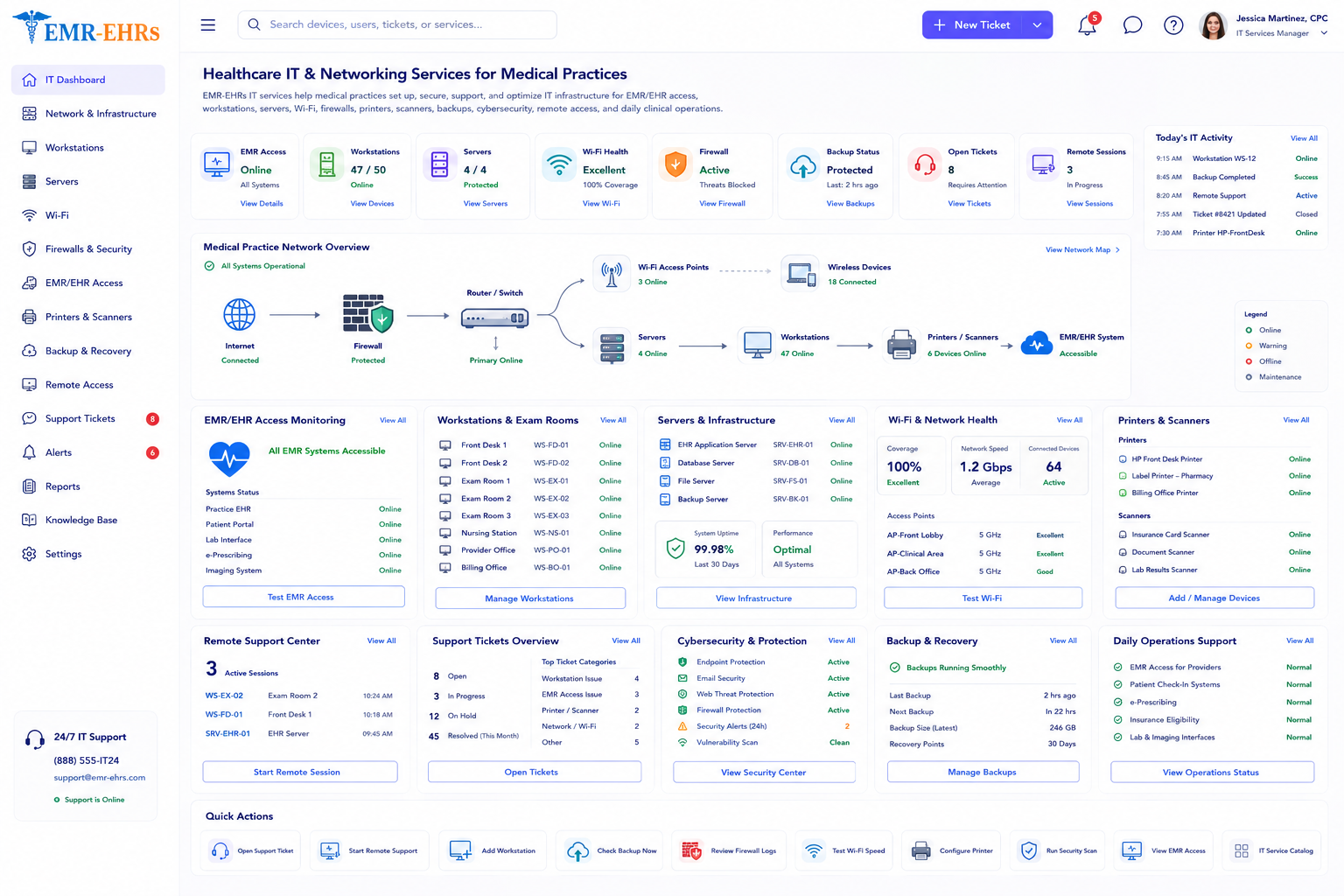
Healthcare IT and networking services help medical practices set up, secure, maintain, and troubleshoot the technology infrastructure used for patient care and daily operations. This can include workstations, servers, routers, switches, firewalls, Wi-Fi, printers, scanners, EMR/EHR access, practice management connectivity, backups, cybersecurity, remote access, monitoring, and support where available.
EMR-EHRs Healthcare IT and Networking Services help medical practices build and support EMR-ready IT environments for providers, clinical staff, front desk teams, billing teams, practice managers, and administrators.
Healthcare practices need reliable IT and network support because unstable systems can affect patient charts, scheduling, billing, scanning, printing, remote access, reporting, and daily practice operations.
Providers and staff need reliable access to patient charts, scheduling, billing, scanning, reports, and patient communication workflows.
Weak wireless coverage can affect check-in, charting, mobile access, patient flow, and staff productivity.
Old desktops, laptops, operating systems, and peripherals can delay documentation, scheduling, billing, and reporting tasks.
Medical practices depend on printers, scanners, insurance card scanning, document uploads, labels, forms, and referral documents.
Network devices need secure configuration, access control, and regular review where supported.
Providers, billers, administrators, and support teams may need remote access, but access must be limited and role-based.
Practices need clear backup scope, restore process, recovery expectations, downtime workflows, and escalation planning where supported.
Medical practices manage sensitive patient data, insurance details, billing records, and operational systems that need careful protection.
IT support must understand how EMR access, billing systems, document scanning, patient portal, reporting, and claims workflows connect.
Access controls, network controls, remote access, device access, backups, and IT inventory should be documented in a privacy-focused workflow.
Multiple locations need consistent network standards, device setup, access rules, support escalation, and EMR connectivity.
Proactive review, maintenance, updates, backups, and issue tracking reduce avoidable disruption where supported.
Providers, front desk users, billers, and managers need a clear way to report, prioritize, and resolve IT issues.
AI-assisted summaries may help review tickets, recurring issues, security gaps, and documentation where available, but final decisions should remain with EMR-EHRs IT specialists, practice leaders, administrators, and vendors.
EMR-EHRs reviews workstations, servers, routers, switches, internet connectivity, Wi-Fi, printers, scanners, users, EMR access, billing tools, backups, and support needs.
Identify how providers, clinical staff, front desk teams, billing users, managers, and administrators use technology every day.
Review internet reliability, bandwidth, Wi-Fi coverage, network devices, cabling needs, and EMR/EHR access performance.
Plan routers, switches, firewall rules, Wi-Fi access, IP addressing, printer/scanner access, multi-user access, and secure connectivity where supported.
Set up or review desktops, laptops, tablets, local servers, cloud access, printers, scanners, label printers, signature pads, and other devices where supported.
Test access to EMR/EHR, scheduling, patient charts, billing, claims, payment posting, reports, document management, scanning, and portal workflows where supported.
Configure staff Wi-Fi, guest Wi-Fi separation, router security, firewall rules, access controls, VPN, and remote access controls where available.
Review endpoint protection, antivirus, anti-malware, patching, password policies, MFA, monitoring, and security update workflows where available.
Review backup scope, restore process, critical systems, recovery expectations, downtime workflows, and support escalation where supported.
Set up provider remote access, billing team access, administrator access, remote support access, device authentication, and access documentation where supported.
Test printing, scanning, insurance card scanning, document upload, labels, forms, EMR document routing, and device connectivity where supported.
Define issue reporting, escalation, monitoring, maintenance, patch review, recurring issue tracking, and support documentation.
Train users on secure logins, remote access, printing/scanning steps, support request process, and escalation.
Review device bottlenecks, Wi-Fi gaps, access issues, backup status, recurring support tickets, and improvement opportunities.
Confirm support for VLANs, internet failover, firewall management, cabling, WAN support, or specific networking methods, including configuration and implementation requirements, during evaluation.
Confirm support for server hosting, cloud server setup, device management, hardware procurement, or specific device support, including configuration and implementation requirements, during evaluation.
Confirm support for firewall management, VLANs, network segmentation, VPN, encryption, or wireless security controls, including configuration and implementation requirements, during evaluation.
Confirm support for 24/7 monitoring, managed detection, endpoint detection, vulnerability scanning, incident response, phishing training, or MFA setup, including configuration and implementation requirements, during evaluation.
Confirm support for uptime commitments, recovery commitments, managed backup, disaster recovery, or backup monitoring, including configuration and implementation requirements, during evaluation.
Confirm support for VPN, remote desktop, hosted access, mobile access, remote support, or remote printing, including configuration and implementation requirements, during evaluation.
Confirm support for cloud hosting, server hosting, managed storage, server management, or cloud migration, including configuration and implementation requirements, during evaluation.
HIPAA-focused IT workflow, designed to support secure access to patient data, audit-friendly IT and access records, role-based access coordination, and privacy-focused IT support.
Confirm support for help desk, onsite support, 24/7 monitoring, managed IT support, or specific SLA, including configuration and implementation requirements, during evaluation.
AI-assisted IT tools should support issue review and documentation while EMR-EHRs IT specialists, practice leaders, administrators, and vendors remain responsible for final technical decisions, security approvals, and support actions.
Need stable EMR access, secure logins, reliable devices, printing, scanning, remote access, and fast issue escalation where supported.
Need workstation access, scanners, printers, patient chart access, device support, and clinical workflow connectivity.
Need scheduling access, check-in tools, card scanners, printers, phones, patient communication tools, and support for daily patient flow.
Need billing system access, claims connectivity, payment posting access, remote access, printing, and secure workstation support where supported.
Need uptime visibility, support process ownership, device inventory, cybersecurity planning, vendor coordination, and recurring issue tracking.
Need user access controls, onboarding/offboarding, security documentation, backup visibility, reporting access, and support escalation.
Need IT support for specialty workflows, imaging, scanning, device workflows, documentation, and specialty system connectivity where supported.
Need consistent network setup, secure access, standardized devices, remote connectivity, and support workflows across locations.
| Workflow Area | Generic IT Support | EMR-EHRs Healthcare IT & Networking Services |
|---|---|---|
| EMR access | May not understand clinical workflows | EMR-ready access and connectivity support |
| Medical office devices | General device support | Workstations, printers, scanners, and practice devices |
| Wi-Fi and network | Basic network setup | Clinical, billing, and admin workflow connectivity |
| Security | General controls | HIPAA-focused access and network planning |
| Remote access | Generic remote login | Permission-based remote access where supported |
| Backup planning | Basic file backup | Critical system and recovery planning where supported |
| Billing workflows | Limited context | Billing, claims, and payment connectivity where supported |
| Scanning workflows | Basic scanner setup | Document and chart workflow support |
| Go-live support | Usually not EMR-specific | EMR setup, rollout, and troubleshooting support |
| Multi-location support | Device-by-device | Standardized practice-wide IT support where supported |
This conceptual workflow preview shows how connectivity, devices, access, security checks, maintenance and support issues can be reviewed together.
EMR, practice management, reports and portal access.
Workstations, printers, scanners and server/cloud access.
Firewall, Wi-Fi, endpoint and access review.
Issue priority, ticket status and recurring trends.
Assess healthcare IT support by environment coverage, security practices, access controls, monitoring, maintenance, incident escalation and EMR workflow knowledge.
EMR-EHRs supports IT environments around EMR/EHR, scheduling, billing, scanning, reporting, patient portal, and daily medical office workflows where available.
EMR-EHRs helps practices review connectivity, workstations, network access, printers, scanners, and EMR performance issues where supported.
EMR-EHRs uses careful access, security, documentation, and privacy-focused IT workflows where supported.
EMR-EHRs helps review endpoint protection, backup planning, recovery workflows, security updates, and support escalation where available.
EMR-EHRs helps standardize device setup, access controls, network workflows, and support across providers and locations where supported.
EMR-EHRs helps providers, staff, billers, managers, and administrators keep technology aligned with patient care and practice operations.
EMR-EHRs can support issue summaries, support trend summaries, backup summaries, and documentation summaries where available.
Review devices, network, internet, users, EMR access, printers, scanners, security, backups, remote access, and support needs.
Plan workstations, servers, network devices, Wi-Fi, printers, scanners, remote access, backup workflows, and security controls where supported.
Configure devices, users, network access, EMR connectivity, printers, scanners, Wi-Fi, firewall, backup workflows, and support tools where supported.
Review user permissions, remote access, endpoint protection, patching, Wi-Fi access, firewall settings, and HIPAA-focused documentation.
Test EMR access, practice management access, printing, scanning, remote access, backup status, Wi-Fi, device performance, and support process.
Guide providers, clinical staff, front desk, billing teams, managers, and administrators on secure access and support workflows.
Review recurring issues, performance, Wi-Fi coverage, device needs, security updates, backups, access controls, and support improvements.
Healthcare IT and networking services help medical practices set up, secure, maintain, and troubleshoot the technology used for daily patient care and operations. EMR-EHRs Healthcare IT and Networking Services can support workstations, servers, Wi-Fi, firewalls, printers, scanners, EMR access, backups, cybersecurity, remote access, monitoring, and IT support where available.
EMR-EHRs supports EMR and EHR connectivity by helping practices review workstations, internet reliability, network access, user logins, printer/scanner connections, practice management access, billing access, reporting access, patient portal access, remote access, and performance issues where supported. This helps providers and staff access patient charts and daily workflows more reliably.
Before using EMR software, a medical office should review internet connectivity, routers, switches, secure Wi-Fi, workstations, servers where supported, printers, scanners, user permissions, remote access where supported, backups, cybersecurity controls, and EMR connectivity testing. EMR-EHRs helps practices prepare these IT workflows before daily EMR use.
EMR-EHRs supports HIPAA-focused IT workflows by helping practices plan secure access to patient data, role-based user access, device access controls, network access controls, remote access controls where supported, audit-friendly IT notes, backup documentation where supported, IT inventory review, and privacy-focused support processes.
Medical practices should choose healthcare-focused IT support because their technology must support patient charts, scheduling, billing, scanning, printing, claims, backups, cybersecurity, remote access, PHI handling, multi-user access, and uptime-sensitive clinical workflows. EMR-EHRs Healthcare IT and Networking Services focuses on medical office workflows, not just general computer support.
Set up, secure, support, and optimize your medical office network, devices, EMR connectivity, printers, scanners, remote access, backups, cybersecurity, and daily IT workflows with EMR-EHRs Healthcare IT and Networking Services where supported.
Phone: (480) 782-1116 | Email: [email protected]
Customer Experiences
Read customer feedback about EMR implementation, practice management workflows, billing, training, support, documentation, scheduling, and daily medical office operations.
Read full testimonialHello my name is Sarah and I wanted to take a minute and tell you about my experience implementing a Podiatry EMR program. We researched for about 18 months and in doing so looked at over 20 different EMR programs. We recently went live with IMS through 1st Providers Choice and were completely thrilled that during the first two months of the transition of going paperless, we showed an increase in productivity even during training and the implementation process. The more we are in the software, the more we find that it has so many capabilities to be efficient for my doctors, my billing coordinator, and the front desk. Support has been good, there were a few occasions where we needed things off business hours, and even then 1st Providers Choice was there for us. We were glad we took our time and looked at several programs before making a decision.
Read full testimonialWe began implementing IMS in our office in April of 2011. This transition was made exceptionally easy with the help of 1st Providers Choice support staff. 1st Providers Choice support staff was quick to respond to all of our support needs during implementation and with any of our current support needs. We were uncertain and a little skeptical about bringing the billing in house because I had never done billing before. Our office was able to bring billing in house during this time of implementing IMS and our revenue is up and our turnaround time is quicker than ever before. We are happy that we decided to go with 1st Providers Choice and made the transition to utilizing IMS for Podiatry.
Read full testimonialChoosing 1st Providers Choice as a business partner has been an excellent choice for our office. We received extensive training from the educational team and find the program to be very user friendly. Scheduling is easy and our billing process has been greatly expedited. The EHR part of the program is easy to work, saves time and helps prevent errors. We have successfully implemented the built-in fax and camera features. 1st Providers Choice is a progressive company that keeps up-to-date on laws and changes and offers excellent support. Thanks, 1st Providers Choice, for helping our office run more efficiently. We really like this program.
Read full testimonialMy bad-debt write-offs have been reduced over 90%. Pre-IMS, we had an average of $80,000 per month outstanding in charges waiting for referral. Since implementation of IMS we now regularly maintain no more than $400 per month. The Authorization tracking screen helps us in timely follow-up with the insurance companies. The billing module is great, in a way we now know what ensures timely payments. The aging reports help our billers set priority of follow-ups, making sure we work in the right areas.
Read full testimonialI just wanted to say that I love IMS!!! We have had other programs in the past but IMS is super!!!! I can bill out charges, enter patient demographics, print patient statements and read the patient ledger much easier. My favorite part of IMS is the billing part. It is so easy to read!!!! Makes my job easier!!!! Thank You!!!
Read full testimonialIMS has improved the billing payment turnaround time. The denied claims have been reduced drastically. The implementation process was smooth and the system is very user friendly.