For Pain Physicians
- Faster charting
- Pain-specific templates
- Medication documentation
- Pain score tracking
- Procedure notes
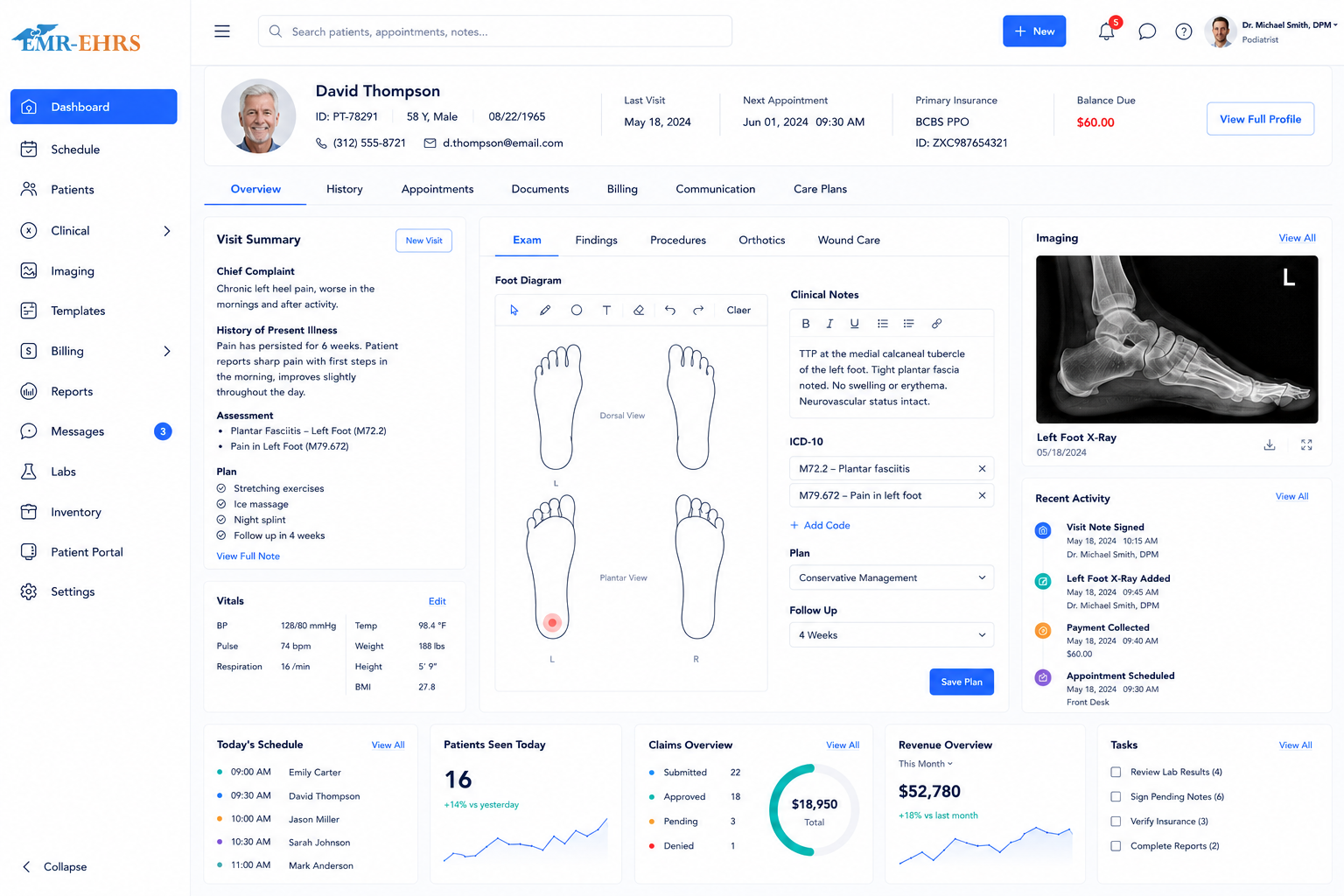
Pain clinics manage recurring visits, procedure-heavy documentation, medication safety workflows, authorizations, imaging records, billing codes, and follow-up care that generic EHR systems may not handle efficiently.
Pain clinics need specialty EMR software because they manage chronic pain documentation, procedure notes, pain scores, opioid documentation, prior authorizations, imaging records, billing codes, and recurring follow-up care that generic EHR systems may not handle efficiently.
Pain management EMR software is an electronic medical record system designed for pain clinics and pain specialists. It helps providers document visits, manage procedures, track pain scores, support medication workflows, organize prior authorizations, handle billing, and improve patient follow-up.
Unlike a general EHR, pain management EMR software should include specialty templates, procedure workflows, pain mapping, treatment progress tracking, e-prescribing support, billing tools, prior authorization tracking, imaging/document management, patient intake forms, and reporting for chronic and interventional pain care.
Templates for initial evaluations, follow-ups, chronic pain visits, back pain, neck pain, joint pain, neuropathy, arthritis, headaches, medication management, and procedure visits.
Structured documentation for epidural steroid injections, trigger point injections, joint injections, nerve blocks, medial branch blocks, radiofrequency ablation, SI joint injections, and spinal cord stimulator trials.
Body diagrams and anatomical documentation workflows for pain location, procedure sites, injection areas, and treatment response.
Track pain intensity, functional status, treatment response, medication response, and long-term patient progress.
AI-assisted note support for visit summaries, structured note drafts, missing documentation alerts, and follow-up task suggestions.
Medication history, allergies, refill tracking, medication changes, controlled-substance notes, and treatment-plan documentation.
Support controlled-substance prescribing workflows, EPCS, PDMP documentation, and safer medication review.
Track authorizations for procedures, imaging, medications, referrals, and payer requirements.
Support pain-specific CPT codes, ICD-10 codes, modifiers, superbills, claim review, and documentation completeness.
Eligibility verification, claim validation, denial management, payment posting, billing reports, workers’ compensation, and personal injury workflows.
Digital intake forms, pain questionnaires, consent forms, medication history forms, and medical history forms.
Store imaging reports, referrals, outside records, consent documents, lab results, and procedure-related files.
Appointment reminders, secure messaging, form completion, follow-up instructions, and patient access tools.
Dashboard visibility into appointments, documentation status, authorizations, billing, claims, follow-ups, and productivity.
A clear template library shows topical depth for chronic pain, procedures, compliance, medication visits, and administrative workflows.
AI can help organize visit details into structured note drafts for provider review.
Summarize prior visits, medications, pain history, procedure history, and follow-up notes.
Highlight missing fields such as pain score, diagnosis, procedure detail, medication change, authorization status, or follow-up plan.
Identify documentation gaps before claims are prepared.
Suggest follow-up reminders, procedure scheduling tasks, or documentation items.
AI-assisted features are designed to support documentation efficiency. Providers should review, edit, and approve all clinical notes, diagnoses, prescriptions, treatment plans, and billing-related documentation before final use.
The most important EMR features for interventional pain management are procedure templates, consent forms, imaging review, anatomical documentation, injection-site tracking, post-procedure instructions, prior authorization tracking, and procedure billing support.
The software can support documentation for opioid-risk and medication-safety workflows. Practices should always follow applicable federal, state, payer, and clinical requirements.
EPCS and PDMP workflows are important because pain management practices often manage controlled-substance prescriptions.
Pain management EMR software helps teams track authorization status, required documentation, payer notes, approvals, and staff follow-up tasks before patient visits.
Pain management billing is procedure-heavy, so coding support should be visible and connected to documentation.
Pain management EMR software helps billing teams connect clinical documentation with CPT codes, ICD-10 codes, modifiers, authorizations, eligibility checks, superbills, claims, and denial management workflows.
Pain clinics often manage occupational injury, auto injury, and long-term treatment cases.
Patient engagement deserves a dedicated workflow, not just a feature bullet.
Pain management EMR software can help track pain scores, functional status, treatment response, medication response, procedure outcomes, and patient progress across multiple visits.
Pain management is recurring-care heavy, so ongoing follow-up tools matter.
Pain management is often multidisciplinary and document-heavy.
Financial clarity helps staff prepare patients before procedure-based visits.
Explore pain management practice management software workflows that connect clinical, administrative, and billing teams.
Integration support helps practices understand whether the EMR fits into their current workflow.
Quality and performance reporting can matter for growing pain practices.
Dashboard visibility turns documentation, authorizations, procedure status, billing readiness, patient follow-up, and staff tasks into one operational view.
| Feature | Generic EHR | Pain Management EMR |
|---|---|---|
| Pain-specific templates | Limited or manual | Built for chronic and interventional pain workflows |
| Procedure documentation | Requires customization | Structured templates for injections, nerve blocks, RFA, and procedures |
| Pain mapping | Usually limited | Body map and anatomical documentation support |
| Pain score tracking | Basic | Longitudinal pain and functional progress tracking |
| Medication workflow | General | EPCS, PDMP, opioid documentation, refill tracking |
| Prior authorization | Often manual | Procedure, medication, imaging, and referral authorization tracking |
| Billing | General billing tools | Pain-specific CPT, ICD-10, modifiers, and procedure billing |
| Patient intake | Generic forms | Pain questionnaires, history forms, consent forms |
| Outcomes | Limited | Treatment response and patient-reported outcome tracking |
| Work comp / PI | Often manual | Case documentation and billing support |
| Reporting | General reports | Pain clinic dashboard, provider productivity, billing, outcomes |
Pain management EMR software includes specialty templates, procedure documentation, pain mapping, opioid documentation, EPCS/PDMP workflows, prior authorization tracking, pain score tracking, and pain-specific billing tools that generic EHR systems may not include.
Look for pain-specific templates, procedure documentation, pain mapping, pain score tracking, EPCS/PDMP support, opioid documentation, prior authorization tracking, coding, billing, patient intake, reporting, customization, training, and support.
Pain management EMR deployment may be cloud-based, on-premises, or hybrid depending on infrastructure, preferences, and security requirements. Learn more about secure EMR medical servers.
Pricing depends on your setup and workflow needs. Do not rely on fake price ranges without approved pricing from the vendor.
Use this educational checklist to compare options without attacking competitors directly.
| Evaluation Area | What to Check |
|---|---|
| Specialty fit | Does it support pain management-specific workflows? |
| Templates | Are pain, procedure, opioid, and follow-up templates included? |
| Interventional workflow | Does it support injections, nerve blocks, RFA, and procedure notes? |
| Prescribing | Does it support eRx, EPCS, PDMP, refill tracking, and medication documentation? |
| Billing | Does it support CPT, ICD-10, modifiers, claim validation, and denial workflows? |
| Authorization | Does it track procedure, medication, imaging, and referral approvals? |
| Outcomes | Can it track pain scores, function, and treatment response? |
| Patient engagement | Does it include intake forms, portal, reminders, and questionnaires? |
| Security | Does it support user permissions, audit logs, and access controls? |
| Deployment | Cloud, server-based, or hybrid? |
| Support | Does the vendor provide setup, training, and ongoing support? |
| Scalability | Can it support solo, group, and multi-location practices? |
This answers a common buyer concern: how hard will it be to switch EMR systems?
Support for documentation, scheduling, billing, procedures, and patient follow-up workflows used in pain management practices.
Configurable workflows based on provider preferences, practice size, and documentation needs.
Integrated administrative and financial workflows for scheduling, eligibility, authorizations, claims, and reporting.
Support for setup, onboarding, workflow configuration, and staff training.
Easy access to demo requests, phone support, and consultation.
Ready to simplify pain management documentation, procedure workflows, authorizations, billing, scheduling, and follow-up care? Request a free demo to see how EMR-EHRS can support your practice workflow.






Make documentation, billing, procedure workflows, authorizations, and follow-up care easier to manage with a pain management EMR solution built around specialty practice needs.
Please do not include protected health information, patient records, usernames, passwords, or clinical details when contacting us.
Customer Experiences
Read customer feedback about EMR implementation, practice management workflows, billing, training, support, documentation, scheduling, and daily medical office operations.
Read full testimonialHello my name is Sarah and I wanted to take a minute and tell you about my experience implementing a Podiatry EMR program. We researched for about 18 months and in doing so looked at over 20 different EMR programs. We recently went live with IMS through 1st Providers Choice and were completely thrilled that during the first two months of the transition of going paperless, we showed an increase in productivity even during training and the implementation process. The more we are in the software, the more we find that it has so many capabilities to be efficient for my doctors, my billing coordinator, and the front desk. Support has been good, there were a few occasions where we needed things off business hours, and even then 1st Providers Choice was there for us. We were glad we took our time and looked at several programs before making a decision.
Read full testimonialWe began implementing IMS in our office in April of 2011. This transition was made exceptionally easy with the help of 1st Providers Choice support staff. 1st Providers Choice support staff was quick to respond to all of our support needs during implementation and with any of our current support needs. We were uncertain and a little skeptical about bringing the billing in house because I had never done billing before. Our office was able to bring billing in house during this time of implementing IMS and our revenue is up and our turnaround time is quicker than ever before. We are happy that we decided to go with 1st Providers Choice and made the transition to utilizing IMS for Podiatry.
Read full testimonialChoosing 1st Providers Choice as a business partner has been an excellent choice for our office. We received extensive training from the educational team and find the program to be very user friendly. Scheduling is easy and our billing process has been greatly expedited. The EHR part of the program is easy to work, saves time and helps prevent errors. We have successfully implemented the built-in fax and camera features. 1st Providers Choice is a progressive company that keeps up-to-date on laws and changes and offers excellent support. Thanks, 1st Providers Choice, for helping our office run more efficiently. We really like this program.
Read full testimonialMy bad-debt write-offs have been reduced over 90%. Pre-IMS, we had an average of $80,000 per month outstanding in charges waiting for referral. Since implementation of IMS we now regularly maintain no more than $400 per month. The Authorization tracking screen helps us in timely follow-up with the insurance companies. The billing module is great, in a way we now know what ensures timely payments. The aging reports help our billers set priority of follow-ups, making sure we work in the right areas.
Read full testimonialI just wanted to say that I love IMS!!! We have had other programs in the past but IMS is super!!!! I can bill out charges, enter patient demographics, print patient statements and read the patient ledger much easier. My favorite part of IMS is the billing part. It is so easy to read!!!! Makes my job easier!!!! Thank You!!!
Read full testimonialIMS has improved the billing payment turnaround time. The denied claims have been reduced drastically. The implementation process was smooth and the system is very user friendly.