1Patient Intake and Referral Source Capture
Capture demographics, insurance, referral source, chief concern, caregiver details if applicable, consent forms, prior records, school documents if applicable, and intake details.
2Insurance, Eligibility, Authorization, and Visit Limit Review
Track insurance details, eligibility, referral requirements, prior authorization status, visit limits, authorization start/end dates, remaining visits, renewal reminders, and missing authorization alerts.
3Patient, Parent, Caregiver, and Contact Information
Collect patient contact details, parent/caregiver information if applicable, emergency contacts, communication preferences, responsible party details, and school or referring provider details if applicable.
4Speech-Language History Documentation
Document developmental history if applicable, medical history, communication concerns, prior therapy, school history if applicable, swallowing concerns if supported, caregiver concerns, functional communication needs, and referral reason.
5Speech-Language Evaluation Workflow
Document assessment areas, articulation, phonology, receptive language, expressive language, fluency, voice, social communication, cognitive-communication if applicable, AAC if supported, swallowing/dysphagia if supported, clinical impressions, diagnosis support, and therapy recommendations.
6Articulation and Phonology Assessment Documentation
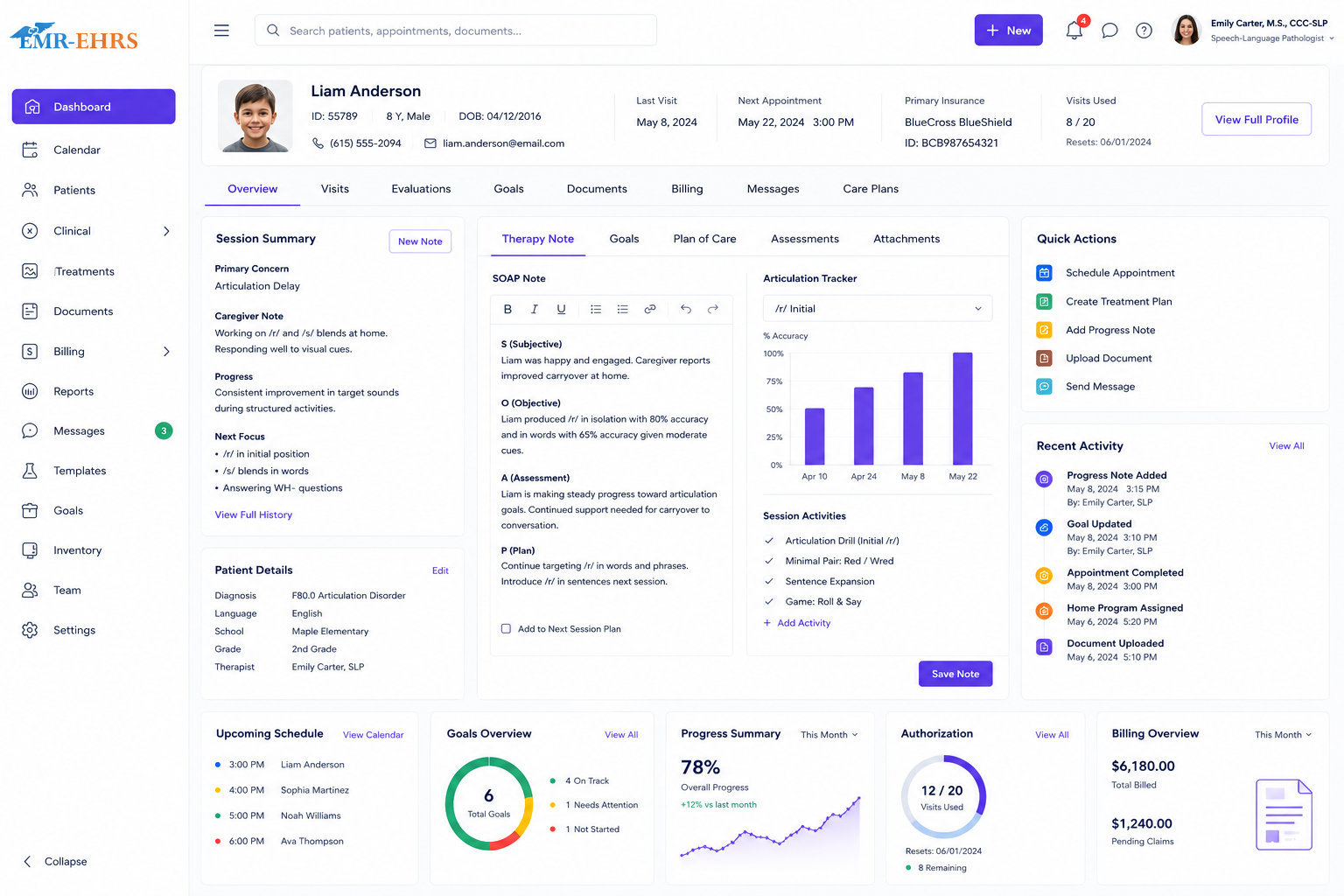
Track target sounds, sound positions if documented, phonological processes if documented, accuracy if documented, cueing level if documented, baseline performance, and recommendations.
7Receptive and Expressive Language Assessment Documentation
Document receptive language, expressive language, vocabulary, grammar, sentence formulation, comprehension, pragmatic/social communication if applicable, functional communication, and assessment findings.
8Fluency, Voice, AAC, Cognitive-Communication, and Swallowing Documentation If Supported
Support documentation for fluency concerns, voice concerns, AAC needs and device trials if supported, cognitive-communication concerns if applicable, swallowing/dysphagia concerns if supported, safety notes if applicable, medical coordination, and follow-up recommendations.
9Treatment Plan and Plan of Care Creation
Create treatment plans with diagnosis, therapy frequency, therapy duration, long-term goals, short-term goals, baseline level, interventions, home practice plan, caregiver education, progress review schedule, and discharge planning notes.
10Short-Term and Long-Term Goal Setup
Create measurable goals, baseline performance, goal status, target skills, goal criteria, progress tracking, modified goals, mastered goals, and next-step recommendations.
11Therapy Session Documentation and SOAP Notes
Document session date, session type, subjective updates, objective data, therapy activities, goal performance, cueing level if documented, patient response, assessment notes, plan for next session, home practice instructions, caregiver communication, and provider signature.
12Session-Level Goal Performance Tracking
Track goal performance per session, accuracy if documented, cueing if documented, response to intervention, progress toward goals, barriers, carryover, home practice completion if documented, and goal updates.
13Home Practice Instructions and Caregiver Communication
Share home practice tasks, caregiver notes, progress updates, education materials, follow-up instructions, secure messages, and therapy recommendations through connected communication workflows.
14Progress Notes and Re-Evaluations
Create progress notes, goal progress summaries, objective updates, functional progress updates, modified goals, mastered goals, continued therapy rationale, re-evaluation findings, plan of care updates, and authorization renewal support if applicable.
15Authorization Renewal and Visit-Limit Tracking
Monitor remaining visits, authorization expiration dates, renewal needs, payer documentation support, missing authorization alerts, claim readiness connection, and billing team visibility.
16Discharge Planning and Discharge Summary
Document discharge criteria, goals met, goals partially met, remaining needs, home program, referral recommendations, discharge reason, final recommendations, and caregiver/patient education.
17Scheduling, Recalls, Reminders, and No-Show Tracking
Manage initial evaluations, recurring therapy sessions, group sessions if supported, therapist availability, multi-provider schedules, cancellations, no-shows, waitlists, reminders, authorization alerts, visit-limit alerts, and patient balance alerts.
18Speech Therapy Billing and Claims
Connect documentation, CPT codes, ICD-10 codes, modifiers, authorization requirements, visit limits, eligibility, claim readiness, electronic claims, denials, payments, patient balances, and A/R tracking.
19Reports and Practice Performance Visibility
Review evaluation volume, therapy visit volume, goal progress, progress notes, authorization utilization, therapist productivity, recurring visit volume, cancellations, no-shows, claims, denials, revenue, and service-type performance.